

















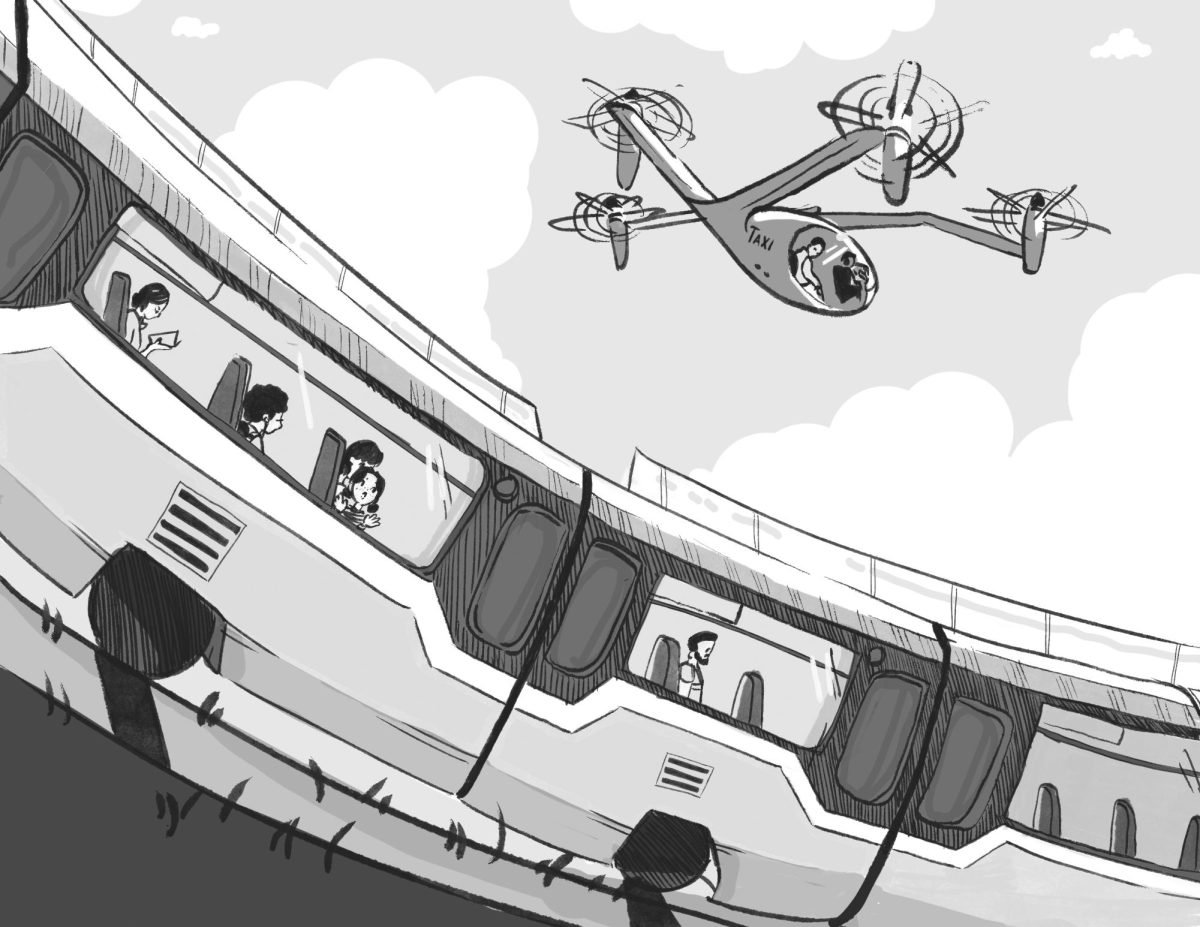
The Federal Aviation Administration has selected the Texas Department of Transportation (TxDOT) to participate in a new program for flying vehicles or air taxis. Texas is one of 26 states participating in an Advanced Air Mobility and Electric Vertical Takeoff and Landing (eVTOL) Integration Pilot Program, which would test routes between DFW, Austin, San Antonio and Houston.
While the prospect of futuristic flying cars seems exciting, the project reveals a glaring issue: The future of American transportation is headed in the wrong direction.
TxDOT plans to implement the federally sponsored program in phases over the next three years. The timeline is shocking as some of Texas’ much-needed highway infrastructure is not set to start construction in the next four years.
The eVTOL project isn’t designed for mass transportation, but rather, short distance transportation of goods and people. The project fails to address the state’s ever-expanding population. It’s the wrong cutting-edge technology for Texas and U.S. investment.
Flying cars may be a sign of the future, but Texas’ future should be public transportation. That technology is high-speed rail.
Texas had one approved high-speed rail project between Dallas and Houston proposed to be in service by 2030. That project is now a private venture after President Donald Trump terminated a $64 million federal grant with Amtrack.
Highway construction projects, car accidents, never-ending lane closures and expansions contribute to a sea of cars lined one behind another moving at a snail’s pace during rush hour.
This is the current experience for Texas drivers. As the second-largest state in the U.S. with a fast-growing population, Texas critically lacks a statewide public transportation system.
The future of the Dallas Area Rapid Transit (DART) is currently in question among many partner cities. The City of Irving’s participation was in question but then resolved. DART provides transportation for many Dallas College students at North Lake and other campuses.
While DART survived council vote in Irving, other public transportation projects may not be as lucky. While critical infrastructure projects struggle for votes, it’s the flashy projects that get publicity and funding.
Texas has a car-centric culture and an infrastructure that fails to address the needs of those who can’t or don’t want to drive a car. Public transportation gives commuters options that may be otherwise unavailable.
People without personal transportation are cut off from economic and social lifelines due to distance.
Public transportation projects will create jobs before and after construction. Access to improved mass transit will impact everyday Texans, people of all ages and income levels. It will decongest our crowded roads, reduce accidents, offer mobility access and connect Texans with economic hubs.
Everything may be bigger in Texas, except its public transportation systems. It’s time to change that.
If projects not critical to all Texans’ needs can get fast tracked and funded, then projects that will directly change and impact most Texans should too.