


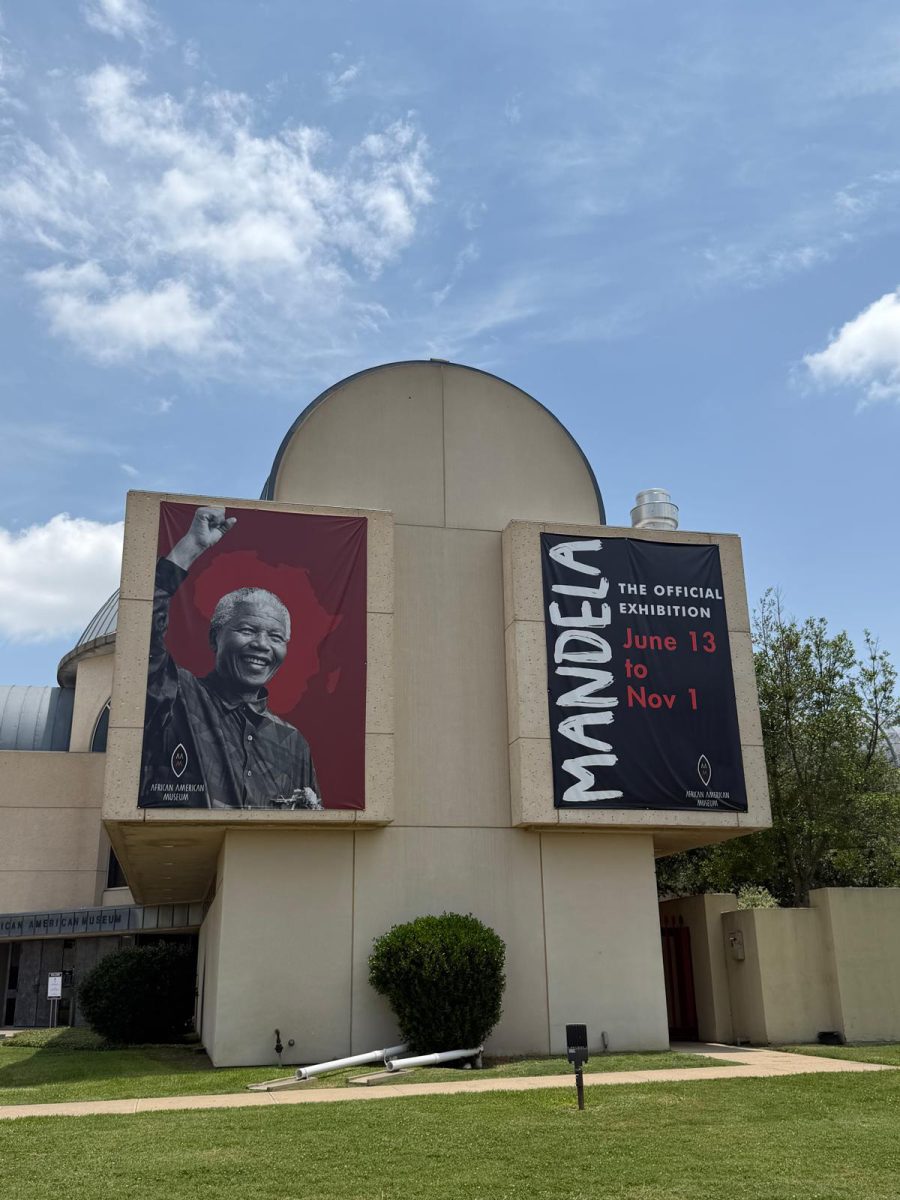









“Mandela: The Official Exhibition,” presented by the African American Museum of Dallas, offers visitors a journey through the life and legacy of the world’s most celebrated freedom fighter, Nelson Mandela. The exhibit runs through Nov 1.
“Some of these artifacts that you see are replicas, and a lot of them are real. Some of the Mandela clothes are real. The white lion is real. The Nobel Peace Prize is a replica,” said Faith Golden, the African American Museum archives’ director.
The exhibition is partnered with Round Room Live, the Royal House of Mandela and authenticated by the Mandela family. Visitors are invited to explore Nelson Mandela’s extraordinary journey through four immersive gallery spaces, including “The Early Years (1918-1941),” “The Struggle is My Life (1941-1964),” “The Prison Years (1964-1990)” and “Freedom and Healing a Nation (1964-1990).”
The exhibition features personal artifacts, multimedia presentations, rare archival photographs and interactive experiences that vividly bring Nelson Mandela’s life, struggles and legacy to life. The African American Museum in Dallas is the only museum in the United States to be able to hold the entire exhibit.
“This is the last time that the exhibit will be in the United States for a very long while. They will go home after this,” said Golden.
Nelson Mandela spent 27 years in prison for his fight against apartheid (segregation between the Black and white residents of South Africa) and his commitment to freedom and equality. After his release in 1990, he played a pivotal role in the country’s transition to democracy. He ran for president of South Africa.
“I witnessed the jubilation of the people when the election came through,” said Linda Jones, a former news and features reporter at the Detroit News covering Mandela’s election.
“It was stressful for a lot of people because when the first results came through, the ANC [African National Congress] was not leading, so people were crying and bawling and they were having a fit, but it was only less than 1% of the vote in,” she said.
In 1994, Mandela made history by becoming South Africa’s president, symbolizing hope, reconciliation and a new era for the nation. The election was international news.
“Media from all over the world covered that historic election of 1994, so there were multiple languages spoken and translators were present,” said Jones.
“As for the people – South Africans are multilingual. The instructions on the official voting ballot were written in 11 languages –no one language on each ballot, but the one-line instructions were written in 11 different languages on the same ballot,” she said.
The 1994 elections in South Africa marked the end of decades of oppression, segregation, and political exclusion. For millions of South Africans, casting a ballot represented far more than a civic duty. It was a long-awaited affirmation of their freedom, dignity and belonging. People traveled to polling stations by any means possible.
“People got to the polls the best way they could; some were driven, others walked, and many were even carried or wheeled to the polls. There were 80 polling places all over rural and urban [communities],” said Jones.
After years of apartheid, no one wanted to be excluded from this defining chapter in South Africa’s history. The overwhelming voter turnout reflected not only the nation’s commitment to democracy but also the resilience, hope and determination of a people eager to shape a more just and united future.
Nelson Mandela set a powerful example for African leaders by voluntarily stepping down after serving a single four-year presidential term. His decision demonstrated that true leadership is rooted in service rather than the pursuit of power, reinforcing the importance of democratic principles and peaceful transitions of leadership.
Throughout his life, he championed humanitarian values, dedicating himself to justice, equality, integrity and the dignity of all people. Mandela’s legacy continues to inspire generations around the world.
“It’s [Mandela’s life] a guide. It’s a point of celebration. It’s a point of knowledge building. But not how we should live our lives, but how a life can be lived and fulfilled and lived with respectful goals,” said Maggie Reese, the African American Museum’s chief programs officer.
Nelson Mandela’s legacy is currently on display at the African American Museum of Dallas, where visitors can immerse themselves in Black history and explore the struggles, achievements, and enduring contributions of African Americans and people of African descent. For more experience, visit their website for more details at https://aamdallas.org/