















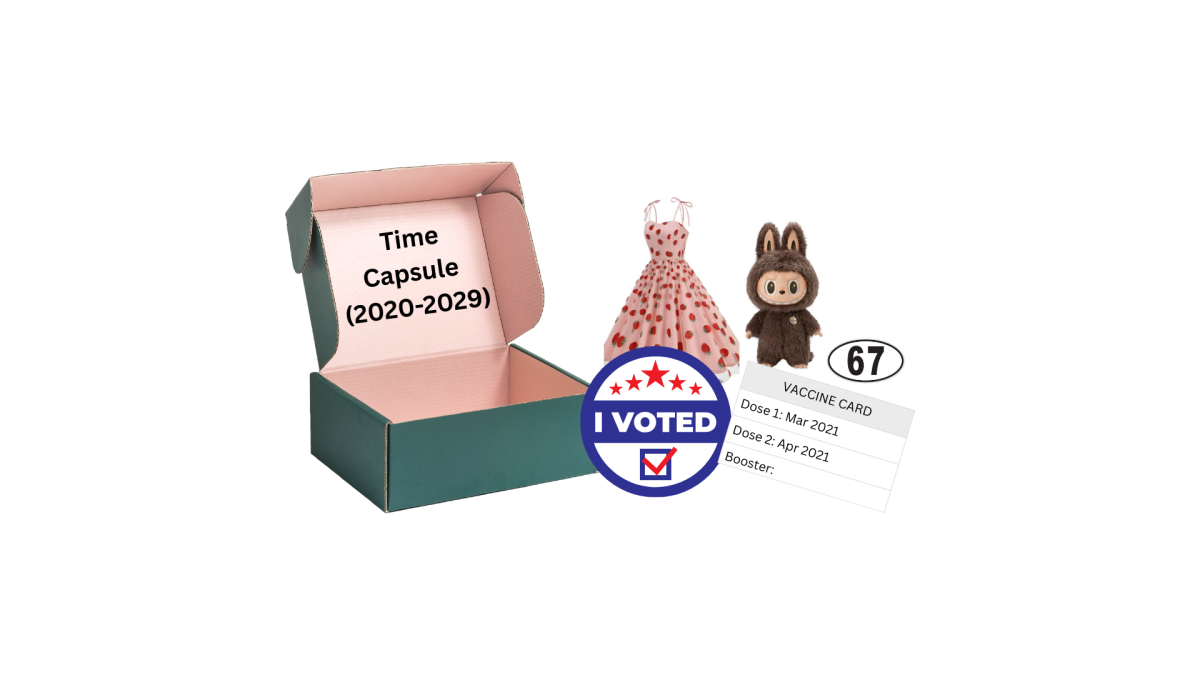
As the end of 2025 closes the first half of the decade (2020-2029), the 2020s have made an impact that would be hard for anyone to deny, and there are still four more years to go.
From the COVID-19 pandemic to changing global politics, the 2020s caused quite a bit of commotion for the entire planet. How will the 2020s be remembered? The hallmarks of the 1980s were defined through bold fashion choices, new-wave identity and Reagan-era politics. The 2000s were defined as the Y2K era amid the worldwide shift that came after 9/11. When people look back to the 2020s in 30 or 40 years, what will they talk about? What will be remembered? What are the defining factors of this tumultuous decade?
“I think COVID’s going to be a major topic, just because its not often we have global pandemics. So, I think COVID would be a big, big thing for historians to look back on, because it’s not just affecting 2020, but it has a long-term effect on our world,” said Dr. Kristin Bocchine, a North Lake history professor.
Apart from a global pandemic and worldwide shutdown, there are many things that define this decade.
Looking specifically at the United States, there has been a big shift in political power throughout the 2020s, with seemingly grandiose sweeps from one political party to the other.
“Shifts in political power. When it comes to history, most historians are always looking at shifts in politics,” Bocchine said.
Starting with the election of Democratic President Joe Biden, we have seen a shift towards more conservative politics.
The first instance was on Jan. 6, 2021, when there was an attack on the United States Capitol by Trump supporters who refused to believe that Joe Biden fairly won the election. This attempted coup solidified the shift towards conservative politics and policies that began brewing in the United States during the latter half of the 2010s.
This shift happened not just among national political leadership, but also sweeping changes in law over the past five years that shifted power from the federal government to the states.
One of the most notable examples was the overturn of the Supreme Court ruling of “Roe v. Wade,” which gave women individual rights over their reproductive healthcare in the 1970s. The repeal of that law occurred in 2022.
“You have the overturning of Roe v Wade, which was a big deal in the United States,” said Bocchine.
The landmark 1973 case was overturned by the Supreme Court in “Dobbs v. Jackson Women’s Health Organization,” with the decision that abortion was not mentioned in the U.S. Constitution and therefore left the decision to states.
This marked a huge change in the United States regarding the definition of healthcare, what counts as abortion and how and when these laws would be enforced from one state to the next.
Other political shifts were witnessed worldwide. The 2020s brought many governmental and political shifts to Britain as well. This started with Brexit, the British exit from the European Union (EU), which happened on Jan. 31, 2020. More changes occurred with the death of Queen Elizabeth II on Sept. 8, 2022, at the age of 96. She was the longest ruling British monarch and the second longest ruling monarch worldwide, only surpassed by King Louis XIV of France.
Britain and the United States were not the only places to experience political shifts.
“The expansion of Russian power. Putin’s control has been solidified,” said Bocchine. “You also have the expansion of Chinese power and the Chinese government, especially in their investments.”
Political power does not often change without force. So far in the 2020s, we have seen many countries being invaded or taken over by another.
The first example was the invasion of Ukraine by Russia in 2022, which escalated the conflict the two countries had been in for almost eight years. Next was the Israel-Gaza conflict, that was resurfaced through the Oct. 7, 2023, attack on Israel by Hamas, killing 1,195 people. Israel retaliated with lethal attacks on Gaza, killing over 70,000 Palestinians and injuring over 160,000 more. Since then, Israel has not relented in their attacks, destroying Gaza and its civilians, resulting in an alleged genocide. That conflict has extended into surrounding countries, including Lebanon and Syria. In Sudan, a civil war broke out in 2023. It has been ongoing, with the military and a paramilitary group (the RSF) fighting for control.
While wars and shifting political power is not new, the use of technology has become widespread. It is much easier to see things happening in real time due to globalization, the rise of the internet in the 1990s and exasperated by the COVID pandemic, during which time the primary means of interaction with others came through a screen.
“One of the things I’m especially noticing, amongst young people is they’re way more global than maybe they were in previous generations and so a lot of our language comes from other places and other cultures. A lot of slang comes from anime and things like that,” said Natalie Pleimann, North Lake Campus English professor. “I think as a people we’re getting more global, but I also think language is getting more global. So [we’re witnessing] more integration of words from other languages and other cultures.”
While the COVID pandemic has seemingly ended, the use of devices as our main source of connection has not. This has led to a widespread “loneliness epidemic” where people have more access to each other yet feel lonelier than ever before. With the introduction of generative Artificial Intelligence (AI), people continue to disconnect from each other as they become infatuated with chatbots and artificially generated material, that lets them feel less lonely when they’re alone.
“There are a lot of things globally in terms of power and that kind of stuff shifting. And the onset of AI, access to it, more importantly generative AI. The easy access of it, which is shifting a lot of things, especially for employment,” said Bocchine.
AI is not only changing the way people interact with themselves and each other but changing the workforce as we know it. Now, it is nearly impossible to apply for a job without a resume being scanned with AI before a human ever lays eyes on it. To improve their odds, applicants have started putting job descriptions into ChatGPT and letting AI create a resume that best fits the job description. Meanwhile, the unemployment rate in the United States continues to go up, with September 2025 being the highest it has been since the pandemic that started the decade.
“I’m hoping it’ll be remembered as the time where we lost our way for a little bit, but then found it again, in a lot of areas,” said Pleimann.
While there are still four more years until the 2020s are over, the decade has already started forming a unique identity. Many things that this period decade will be remembered for may have already happened. From the COVID pandemic to the rise of internet usage, we are connecting to the world in a way that has never been seen before. Add shifting politics and a world driven by AI, the 2020s are sure to be a decade remembered in the history books.